
|
|
A Brief Archaeological History
The Stone Age
The Bronze Age
The Early Iron Age
The Early Christian Period
The Medieval Period
Some Sites Worth A Visit |
Senchathraig na ngennti
Imma rerad rudrad
It fassa cen adrad
Amail lathrach Lugdach.
Old haunts of the heathen
Filled from ancient days
Are but deserts now
Where no pilgrim prays.
Oengus of Clonenagh (c. 800 A.D.). |
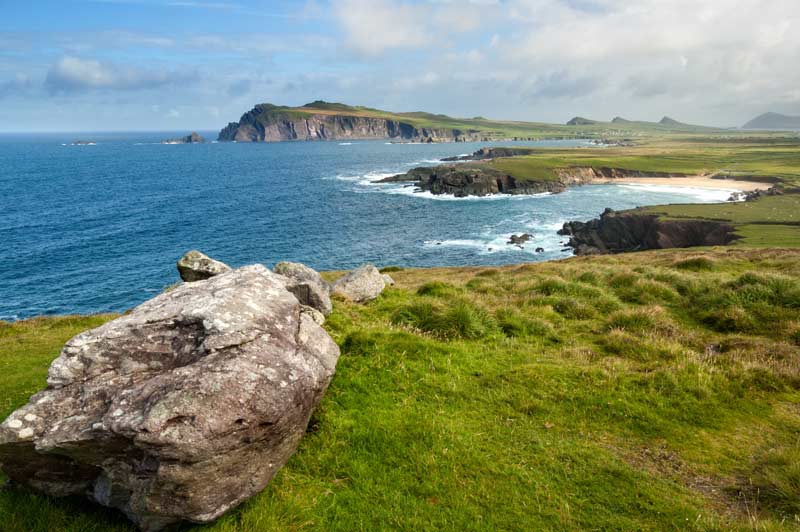
The Dingle Peninsula, situated on the extreme south-west of Ireland, has had a rich and varied history and, indeed, prehistory. The net result of this, along with the relatively high rate of monument survival in this area, is that there is much here to interest those of an archaeological inclination, both the casual observer and the serious scholar. |
The Stone Age (c. 5000-2200 B.C.).
The earliest indication of human activity on the Dingle Peninsula ( Corca Dhuibhne in Irish) is at Ferriter's Cove near Ballyferriter. Excavations at this coastal site identified it as the seasonal settlement of a group of Fisher-gatherers of the Mesolithic/Neolithic transition period. Radiocarbon samples recovered here range between 3670 and 3240 B.C. and the stone tools recovered on the site were of typical Mesolithic type. Unfortunately, the effects of coastal erosion over the millennia has meant that there is no surviving surface evidence of this activity. |
 |
Gallarus Oratory, One of the best known Irish Monuments.
Though a late example, the above site is clearly that of a nomadic foraging society. Of the farming evidence which commonly marks the Neolithic period (c. 4000-2200 B.C.) elsewhere in Munster there is little sign on the Dingle Peninsula. There are a number of undated fieldwall systems which may prove in the future to be Neolithic in date, as they have elsewhere in Ireland, most notably at the Ceide Fields in north county Mayo. Also, many of the single Standing Stones (known as Gallauns) which characterize the landscape may belong to the Neolithic rather than the following Early Bronze Age (c. 2200-1400 B.C.). |
| [Back To Top] |
|
|
The Bronze Age (c. 2200-400 B.C.).
The Dingle Peninsula appears to have experienced something of a population explosion during the Bronze Age, if the quantity of monuments of that period surviving in Corca Dhuibhne are anything to judge by. The wedge-tombs are the last tomb type in the Megalithic tradition of building to have been constructed in Ireland and, it seems, in Western Europe. They are also the only Megalithic tomb type found in the Dingle area. The Dingle Peninsula Archaeological Survey (pub. 1986) recorded ten wedge-tombs. However, their modest size in comparison with their better known relatives, such as passage tombs, means that many examples may remain undiscovered in the landscape. Indeed, a previously unidentified wedge-tomb was recently discovered by a local archaeologist built into a wall-system at Ballymore West, Ventry.
Many of the abovementioned standing stones are likely to be of Bronze Age date also. Such standing stones occasionally occur in pairs and, more rarely, in alignments of three or more. The religious and/or ritual nature of these constructions is underlined by the fact that, like wedge-tombs, the alignments are often focussed on specific solar or lunar events. For example, one alignment at Ardamore, Lispole centres on the rising point on the horizon of the sun on the Winter Solstice. Another at Cloonsharragh, Brandon focusses on the rising point of the sun on the Summer solstice. |
What is it saying??
A further puzzling monument type left to us by our Bronze Age forebears are the numerous boulders featuring 'Rock Art'. Taken together, the Dingle and Iveragh Peninsulas constitute the largest concentration of this rock art in Ireland. Unlike Bronze Age rock art in Scandinavia and Iberia, the Insular style found throughout Ireland and Britain is purely non-representational and abstract. Its motifs consist mainly of two elements; the circular ring and the cupmark (see diagram), sometimes joined by straight or curved lines. The meaning and significance of this elusive art has long been a subject of debate. |
|
Maps, astronomical charts and territorial markers are among the many purposes suggested. One thing is likely, that their significance is, again, primarily religious in nature. Ritual complexes, incorporating both standing stones and rock art (and occasionally other monuments such as chamber cairns, stone circles and wedge-tombs) occur in a number of locations in Britain and Ireland, such as the impressive example at Kilmartin Glen, Argyll in Scotland. A small version of such a complex can be seen at Miltown, just outside Dingle town. This site, known locally as Geata na Gloire (the Gates of Glory) consists of several pairs and several single standing stones, some of which feature rock art. Another such 'ritual landscape' exists in the remote Lochadoon valley (see below).
|
|
 |
A Lunula: The Zenith of Irish Sheet-Gold Working
This vast array of ritual monuments contrasts greatly with the absence of identified Bronze Age settlement sites on the Dingle Peninsula. However, Bronze Age settlement is notoriously difficult to identify throughout the country, so the situation in Corca Dhuibhne is unremarkable. Nonetheless, industrial activity of this period is seen in a number of metalwork finds on the Peninsula, including both flat copper axes of Early Bronze Age date and socketed bronze axes and spearheads of the Late Bronze Age. A gold lunula of the Early Bronze Age, found near Inch on the southern side of the Peninsula, is perhaps the most spectacular find made to date.
(see diagram at right.) |
| [Back To Top] |
|
|
The Early Iron Age (c. 400 B.C.-450 A.D.).
The Early Iron Age on the Dingle Peninsula is obscure, as it is throughout southern Ireland. The fine metalwork of La Tene type, considered characteristic of Celtic society which supposedly commenced at this time in Ireland, is almost entirely absent from Munster. This is a fact which has led some scholars to suggest that a vigorous Late Bronze Age society survived in the Southern part of the country long after the Iron Age had taken hold in the northern part of Ireland. This matter is very much open to interpretation. It is also difficult to pin down characteristic monument types of the Early Iron Age. On the Dingle Peninsula the inland promontory forts at Caherconree and Faha (the latter being the highest fort in Ireland at 2500 feet or 762m O.D.) may be of this period, as may some of the uninvestigated coastal cliff-top promontory forts, of which there are at least twenty on Corca Dhuibhne. |
Pagan Celtic Idol?
A carved stone head, considered to be of 'Pagan Celtic' type was, prior to it's recent theft, built into the wall of a Medieval church in Cloghane. Up until recently this head was involved in the Christian pilgrimage to the summit of Mount Brandon (Ireland's second tallest peak), at the foot of which Cloghane is situated. This head was known locally as Crom Dubh (Black Crom) after the Celtic God Crom Cruach. In the light of these facts it seems likely that religious importance was accorded Mount Brandon in pre-Christian times, a notion also supported by the many Bronze Age ritual monuments of the types discussed above which cluster in the vicinity of this mountain.
|
|
| [Back To Top] |
|
|
The Early Christian Period (c. 450-1000 A.D.).
The Early Christian Period is an era for which the Dingle Peninsula is rightly renowned. The new religion appears to have taken root quickly and vigorously in this area, the extent of missionary activity being marked by a wealth of archaeological remains. There are over sixty confirmed early ecclesiastical sites on the Peninsula, as well as a large number of isolated oratories, ogham stones, cross-slabs, souterrains and ancient burial grounds. Many of these monastic settlements took the form of small, isolated communities following an ascetic rule which is sometimes claimed to have been inspired by the great eremitic tradition of early Coptic christianity in the Egyptian desert. Indeed, although absent from the Dingle peninsula, the place name element ' Dysert' is associated with a number of locations which were linked with early Christian foundations. In this context Dysert or desert means an isolated place deserted by people, rather than a desert in the ecological sense. The most thoroughly investigated early monastic site on the Dingle Peninsula is that at Reask, near Ballyferriter (see below). Other religious settlements were less contemplative and more outward-looking in nature. The large ecclesiastical complex at Kilmalkeadar (see below) was, for several centuries, to rival Ardfert in a struggle to become the ruling seat of the Kerry diocese. Other ecclesiastical sites worth a visit are those at Teampall Manchain, in Ballymorereagh and the well-known oratory at Gallarus (see below). |
 |
The Ancient Celtic Alphabet.
There are over sixty ogham stones on the Corca Dhuibhne, constituting one of the largest concentrations in existence. Ogham is an alphabetical system characteristic of early 'Celtic' Christianity which is found mainly in Ireland, Cornwall and south Wales, spreading into the latter two areas as the result of Irish colonization in the Late Roman period. The ogham script is based upon a series of cuts and notches inscribed perpendicularly into a stone off a vertical axis, in practice often the corner of a pillar (see diagram). The main importance of ogham is that it supplies the earliest written Irish, predating the oldest surviving manuscripts by several centuries. The origins of ogham are still hotly debated, but a date of origin around the Fourth Century A.D. is likely for this enigmatic script.
The abovementioned souterrrains were a feature of both ecclesiastical and secular settlement in the Early Christian Period, They consist of a chamber or chambers, usually of drystone construction, built underground and joined by tunnels. Their original purpose was probably mainly storage, although the defensive features found in some passages and references to souterrains in the monastic annals make it clear that short term refuge in times of danger was another important use.
|
In modern times such ancient souterrains have been used for other worthy purposes, such as a safe place of concealment for caches of poitin. The main form of secular settlement in use during the Early Christian Period in Ireland was the ringfort. These consist of a roughly circular area surrounded by a bank and external ditch (though occasionally more than one bank and ditch were built). Depending on the terrain, the method of construction was either using earth (such an earth-built ringfort is known as a Rath or Lios) or using stone (termed a cashel). These are the most plentiful archaeological monument type in Ireland, being a familiar sight to both native and the perceptive traveller. |
|
Dunbeg Fort in it's dramatic setting.
The number of surviving ringforts in Ireland is calculated at between 30, 000 and 40, 000, yet there may originally have been more than twice as many as this. Ringforts often lack any surviving internal features, but many have the remains of circular stone dwellings (called clochauns) and/or souterrains within them. Good examples of ringforts can be seen at Kilvickadownig, Ballyhea and Caherdargan North.
Many of the coastal promontory forts mentioned previously would have been inhabited at this time, such as that at Dunbeg, Fahan.
(See picture at right.)
[ Back To Top] |
|
|
The Medieval Period (c.1000-1600 A.D.).
From about the Twelfth Century A.D. on, the new institutions of the Norman feudal system and increasing centralization of power by the Roman church began to tell on the native Gaelic society of west Kerry. A large number of churches were built in this period, although only a handful of these survive today. With the exception of the relatively ornate Romanesque chapel at Kilmalkeadar (see below), these are of quite simple form with little ornamentation and no apparent division between the nave and chancel areas of the church.
|
The Family Seat of Rahinane.
|
The chapel at Ballywiheen is a good example of this type. The dominant family in Corca Dhuibhne during the Medieval period was the west Kerry branch of the Hiberno-Norman sept, the Fitzgeralds, who held the title 'Knights of Kerry'. The Fitzgeralds constructed a number of 'castles' (in reality fortified tower-houses) in the western part of the Dingle Peninsula, examples of which survive at Gallarus, Minard and at the family seat of Rahinane (see below). The ruined remains of a family belonging to the Ferriter family may be seen on a headland at Ballyoughteragh near Ballyferriter. This tower fell into disuse after the capture and execution of the Irish poet and rebel leader Piaras Ferriter by the English in 1653. Likewise, all the Fitzgerald castles were either captured or destroyed by Cromwellian forces around 1650, bringing an end to Gaelic supremacy on the Dingle Peninsula. Other interesting archaeological remains from this period worth a visit are the Medieval bridge which still stands at Garfinny to the east of Dingle town and the promontory fort of Dun an Oir, the site of an infamous massacre during the Tudor Period (see below).
[ Back To Top] |
|
Some Sites Worth a Visit
Listed below are just a small selection of the hundreds of archaeological sites on the Dingle Peninsula which the visitor will find of interest. Apart from the fascination of these archaeological monuments themselves, their builders often chose to site them in some of the most beautiful places on the Peninsula, in locations with a view commanding vast areas of the surrounding countryside. These sites can all be reached from the Rainbow Hostel or from Dingle town itself on foot or by bicycle.
This well-preserved tomb is situated dramatically on the ridge above the tiny village of Caherard (see left), commanding a wide view both south over Ventry, with Dingle Bay and the Iveragh Peninsula beyond, and eastwards over Dingle town. The tomb has three capstones and measures about four metres in length, its long axis being aligned east-west. It seems likely that the tomb was originally surrounded by a low mound or cairn. The tomb is known locally as Leaba an Fhir Mhuimhnigh (the Munsterman's Bed), a name resulting from the connection in folklore between this site and the epic tale of the Fenian Cycle, Cath Fionntra (the Battle of Ventry Beach). In this story the legendary Fianna under Fionn Mac Cumhaill fought with the armies of the King of the World, Daire Domhain, on the strand for a year and a day before the invaders were repulsed with the aid of the Celtic Sea-God Mananann Mac Lir. |
The Lochadoon Valley, Cloghane
The Lochadoon Valley (See Left), a beautiful and secluded area in the mountainous interior of the Peninsula, is possessed of an impressive array of archaeological monuments of Bronze Age date. These include examples of rock art, a wedge-tomb, standing stones and a fortified island, the latter is of uncertain date and gives the valley its name Loch an Dun (the Lake of the Fort). Also present in the area are a number of pre-bog field wall systems, which may be prehistoric, and several Fulacht Fiadh (also known as BurntMounds). |
|
These are ancient cooking sites, the use of which is described in the early Irish literature (although many date as early as the Bronze Age). First a stone or timber-lined trough near a stream would be filled with water and then rock would be heated in an adjacent fire before being dropped into the water, a process which was continued until the water boiled. Joints of meat were then placed in the water to boil. Although this may all sound somewhat unlikely, modern archaeological experiments have shown it to be a quite economical and effective method of cooking. It has also been suggested that Fulacht Fiadh were used for bathing or as saunas. The Lochadoon area has been closely studied for several years by local archaeologist Micheal O Coilean, who runs tours to this and many other interesting sites on the peninsula. |
|
Caherconree Hillfort, Camp
On a clear day this fort controls an amazing vista over Kerry and Beyond, with Loop Head in county Clare visible to the north, the Blasket Islands to the west and the Macgillicuddy Reeks, Ireland's highest mountain range, to the south. The fort itself is situated high up (c. 2050 feet / 625 metres O.D.) in the Sliabh Mish mountains. Three sides of the promontory on which it is situated are protected by steep cliffs, while the fourth to the east is defended by a drystone wall which, although collapsed in places, has a maximum height and width of 3 and 4.5 metres respectively. There is some indication of a small bank and shallow ditch outside the wall at north, while the ruined remains of four or five huts abut the inside of the wall. The fort gets it's name from a legendary Kerry man, Cu Raoi Mac Daire, who features in the famous Ulster Cycle of legends. Cu Raoi was a magician and warrior who holds the redoubtable claim to have been one of the few men to defeat the legendary Cuchulainn in battle. Not content with this, Cu Raoi then shaved Cuchulainn's long hair off as a mark of shame! Cuchulainn subsequently gained his revenge by killing Cu Raoi in an act of trickery, when his weapons had been hidden by a treacherous lover. |
Reask Early Monastic Site, Ballyferriter
Reask is certainly the most thoroughly investigated site of its type on the Dingle Peninsula, having been exhaustively excavated by Dr. Tom Fanning in the early 1970s. The site has since been conserved by the Office of Public Works. It consists basically of an enclosing wall or vallum, an oratory and graveyard with slab shrine, several beautifully engraved cross-slabs and half a dozen circular cells or clochauns. The graveyard had, like many early Christian cemeteries, been reused in more recent times as a burial place for unbaptised infants refused burial in consecrated burial grounds. Early Christian areas reused in this way are known as ceallunacha. Radiocarbon dates suggest the foundation originated in the Fourth or Fifth Century A.D. Finds from the clochauns include evidence of of iron, bronze and possibly glass-working, as well as wool-spinning. A corn drying kiln situated just outside the vallum at west and a number of quernstones indicates the cultivation of cereals by the monks. Monastic activity at Reask seem s to have ended some time in the Twelfth Century A.D. The recovery of shards of Late Roman Amphorae (known as B-Ware) dating to the Seventh Century suggests that the site had good connections with the wider European world at this time, and we may wonder if such small monastic settlements were really so introverted and cut-off from the material world as has been suggested. Reask is situated about a mile outside Ballyferriter on the main Dingle road. The turn-off for the site is beside Brick's Pub, where one of the best pints of Guinness in Corca Dhuibhne can be consumed while mulling over the virtues of the simple monastic life. |
 |
Kilmalkeadar Ecclesiastical Complex
The many monuments at Kilmalkeadar are of both Early Christian and Medieval date, and are spread over an area of about ten acres. This site was traditionally founded by Saint Maolcethair, an Ulsterman who died about 636 A.D. There are a number of excellent pillar monuments here, including an ogham stone, alphabet stone, stone cross and a beautiful sun-dial. The Romanesque church is the focal feature of the complex, with one of the finest doorways in that style in Ireland, comparable in quality to those at Clonfert, Inisfallen and Inchagoill. The door has outstanding mouldings in chevron and beaded style, with a central carved figurehead above the arch. The chancel arch and finial are also well executed. A date in the mid Twelfth Century is likely for this building. Two medieval stone houses are also present. |
The 'Chancellor's House' survives only as it's ground floor plan, while 'St. Brenda's House' survives up to it's first storey, displaying some high quality stoneworking. An early boat-shaped oratory of similar type to that at Gallarus, but with a partially collapsed roof, lies some 400 metres to the north-west of the Romanesque church. |
|
Gallarus Oratory
This tiny church, built with only stone and mud, is one of the best-known archaeological monuments in Ireland. The simplicity of its conception and the almost unbelievable level of masonry skill employed in its construction combine to fashion a building of absolute basics, yet which is hugely pleasing to the eye. As far as durability is concerned, the fact that the oratory has stood for about a thousand years without the use of mortar and without the need for substantial renovation speaks for itself. The building, constructed of sandstone rubble, measures 6. 86 by 5. 74 metres externally. There is a single lintelled doorway in the east and a single small arched window opposite in the western gable. No internal features survive. The roof is formed as an extension of the drystone walls in the technique known as corbelling, using no beams or flags. This building tradition stretches back to the passage tombs of the Neolithic (third Millennium B.C.) in Ireland and was used up until the last century in the Dingle area. The date of construction of this oratory is a subject for debate, but most estimations fall in the centuries on either side of 1000 A.D. |
Dunbeg Promontory Fort, Fahan
This fort is situated on the southern cliffs of the Dingle Peninsula at Fahan just off the road between Slea Head and Ventry. Extensive excavations were undertaken here in the late 1970s, as tidal erosion was causing much of the site to fall into the sea. The defences consist of four earthen banks, five ditches and an internal drystone rampart. The banks are up to 1 metre high and 3 metres wide, while the ditches vary between 1 and 1.5 metres in depth. Excavation suggests there may have been a wooden palisade fence surmounting the innermost bank and possibly the second bank. Access to the interior is provided by a causeway kerbed on either side with stone slabs. The inner stone rampart is of impressive dimensions, up to 6.3 metres thick and 3 metres high. Entry is through a lintelled passageway which features bolt-holes allowing the door to be locked from the inside. The bar was controlled from two internal 'guard-chambers', one on either side of the passageway. A drystone built souterrain, starting from within the passage, extends for some 16 metres to the north. The main feature within the rampart is a large stone clochaun, some 7.5 metres in diameter. The main periods of occupation were marked by quantities of sheep, pig, goat, deer, cattle, fish and bird bones, and the interior of the clochaun had three hearth sites, as well as several stake settings suggestive of tripods for holding pots or skins over the fire. This occupation was dated by radiocarbon to the Eighth or Ninth Centuries A.D. A Ditch and fence underlying the stone rampart gave a date of 580 +or-35 b.c., suggesting a much earlier period of activity at this site in the Late Bronze Age. |
Rahinane Castle, Ventry
Rahinane castle was constructed in the interior of a pre-existing large bivallate (double banked) ringfort. It is situated on the south side of Mam na Gaoithe, the gap over the hills between Ventry and Ballyferriter parishes, with a commanding view over Ventry harbour and Dingle Bay. Rahinane castle was the seat of the Kerry Fitzgeralds who had several other fortified tower-houses on the western part of the Peninsula. The present structure at Rahinane is likely to be of Fifteenth Century date. The castle was partially destroyed by the Cromwellian forces around the middle of the Seventeenth Century, although the Fitzgeralds remained in occupancy at the site until the early Eighteenth Century. The outer defences are quite formidable, with the depth from the top of the inner bank to the bottom of the ringfort ditch being up to 8 metres in places. There are entrances at the north-west and east sectors of the defences. The castle itself is a rectangular tower-house with projecting turret on the north wall. The keep consists of three storeys. The walls are built of coursed rubble set in a sea-sand mortar, with dressing of wrought sandstone. The ground floor entrance, at the west end of the southern wall, has a slot which originally probably held a portcullis, the machinery of which may have been controlled from an embrasure above the door in the second storey. Little of the turret now survives, but one interior chamber in its ground storey appears to have been unlit and may have been a dungeon. The first floor of the cattle may be reached by a stone staircase, but is difficult to explore, as much of this floor was originally of timber and is now absent. The second floor of the castle is now inaccessible due to collapse of the stair in the south wall. |
Dun an Oir (Castelle del Oro), Smerwick
The promontory fort of Dun an Oir, refortified in the Tudor period, lies on the west side of Smerwick Harbour. In 1580 six ships, carrying 600 to 700 Spanish, Italian and Irish soldiers, left Santander and sailed for Dingle. The force was a response by the Pope and the King of Spain to a request for military aid from the rebelling Earl of Desmond and his Gaelic followers. The fleet arrived in Dingle in early September but were turned away by the residents of Dingle town, afeared of the English retribution. The invasion force arrived in Smerwick Harbour on the north of the Peninsula several days later where the troops disembarked and began to fortify a local fort owned by the Rice family at Dun an Oir. When the English forces arrived and set siege on the 8th of October the defences remained uncompleted. The government forces were commanded by Lord Grey and the Earl of Ormond, while the cavalry were led by Edmund Spenser, the poet famed for his composition 'The Faerie Queen'. However, the deeds of Spenser and his compatriots at Dun an Oir were to be less than poetic. A fleet of English ships under Admiral Winter cut off the entrance to the Harbour, preventing any escape by that route. After only three days of siege, and despite having provisions for six months and munitions for 4000 troops, the Spanish commander, Sebastiano di san Giuseppe, surrendered. The same day, October the 10th, all 600 of the garrison, including women, were massacred, beheaded and thrown into the sea. Some 20 people, including di san Giuseppe, were spared.
This site is now much overgrown, but a number of features survive to bear witness to this poignant and savage event. There is an external rampart with maximum height of 1.5 metres. This bank is flanked by two level bastions which an ordnance plan from the 1580 siege shows as bearing a cannon each. The entrance to the fort itself is barred by a deep gulley crossed now by a narrow causeway, but which had a drawbridge at the time of the massacre. The oval promontory, some 26 by 16 metres in size, is surrounded by a low bank. There are two gun emplacements at the fort entrance above the causeway and two or possibly three more at the extreme seaward end of the promontory. The outline of several hut foundations are traceable in the interior. Finds from the site include cannon balls, a rim-sherd of high quality continental ware of 16th Century date, a buckle from a military uniform, a lead ingot and some fragments of cast bronze gun. A memorial erected in conjunction with the Spanish embassy now stands near the site. Local tradition is that many of the victims of the massacre were buried at the early ecclesiastical site of Teampall Ban (the White Temple) on the south-west shore of Smerwick Harbour. This is particularly interesting in the light of the fact that tidal erosion of sand-dunes at the latter site has recently uncovered numbers of skeletons (1996).
[ Back To Top] |
The above brief discussion and descriptions are only a small taste of the vast legacy of monuments constructed over the last six thousand years which constitute the unique archaeological heritage of Corca Dhuibhne and which continue to play a role in shaping the present lanscape of this western outpost of Europe. To truly appreciate the depth and richness of this legacy one must take the next step and experience it with one's own senses. |
-All the above photos were extracted from "The Dingle Peninsula Archaeological Survey" (1986), head editor Judith Cuppage, with the exception of that of the lunula, which is from "Early Irish Art" (Department of Foreign Affairs) by Maire de Paor.
[Back To Top]
[Back To Activities] |
|
|